 Skip to content
Illustrative Use Case
The Situation
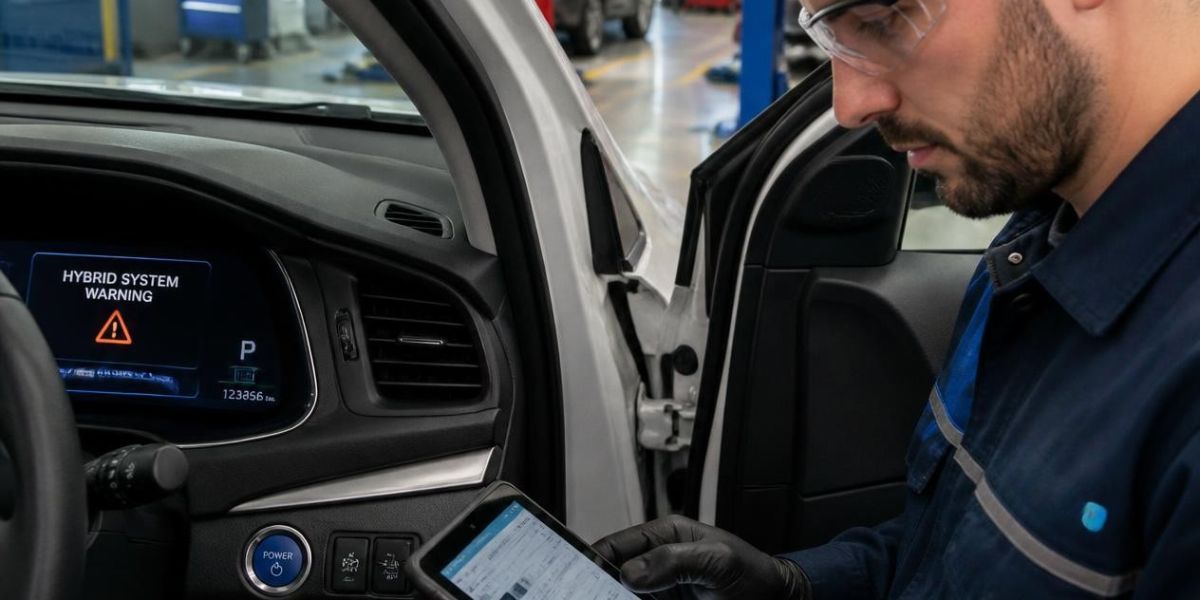
A hybrid vehicle shows a warning light on the dashboard.
The warning may appear to suggest a battery problem.
However, a warning light alone does not confirm that the hybrid battery is the cause.
Hybrid vehicles contain several connected systems.
A fault in another component may also trigger a warning or affect how the hybrid system operates.
Before battery repair or replacement is considered, the source of the problem needs to be investigated.
The Challenge
Dashboard warnings can create uncertainty.
The vehicle owner may assume that the hybrid battery has failed.
A workshop may also find battery-related fault codes stored in the vehicle.
But fault codes need to be reviewed together with battery data and other diagnostic information.
A code can identify where further investigation is needed.
It does not always confirm which component should be repaired or replaced.
The challenge is to separate a confirmed battery problem from another vehicle fault.
The Diagnostic Approach
The assessment begins with structured vehicle and battery diagnostics.
The process may include:
- Reviewing dashboard warnings
- Reading stored diagnostic trouble codes
- Checking battery-related fault codes
- Reviewing live battery data
- Comparing battery module or block readings where available
- Checking battery temperatures
- Reviewing charging and discharging behaviour
- Checking communication between related vehicle systems
- Looking for other faults that could affect hybrid operation
The findings are then reviewed together.
The aim is to understand whether the warning is directly connected to the battery or whether another system requires further investigation.
Why Fault Codes Need Further Investigation
A fault code is an important starting point.
It helps identify the system where a problem has been detected.
However, it should not automatically lead to a battery replacement decision.
The same warning may require several checks before the cause becomes clear.
For example, further diagnostics may be needed to understand whether the issue relates to:
- Battery performance
- Uneven module behaviour
- Battery temperature
- Electrical connections
- Sensors
- Battery management components
- Communication faults
- Another part of the hybrid system
The correct assessment depends on the vehicle, battery design, fault information, and diagnostic findings.
Possible Diagnostic Findings
A structured assessment may show that:
- The warning is linked to the hybrid battery
- One or more battery readings require further investigation
- The battery appears to be operating within the available test parameters
- Another hybrid system component may be involved
- An electrical or communication fault requires investigation
- More detailed testing is needed before a service decision can be made
Each finding leads to a different next step.
This is why diagnosis should come before repair or replacement.
Supporting the Next Decision
Once the available diagnostic information has been reviewed, the workshop or vehicle owner can consider the appropriate next action.
Depending on the verified findings, this may include:
- Further battery testing
- Investigation of another vehicle system
- Approved battery repair
- Battery component replacement
- Battery reconditioning
- Hybrid battery remanufacturing
- Complete battery replacement
- No immediate battery work
The next step should be based on evidence from the assessment.
How Zentiq Energy Supports the Process
Zentiq Energy supports structured battery testing and diagnostics.
This includes battery assessment, diagnostic processes, health information, reporting, and clear findings that can support the next decision.
The EV Diagnostic Franchise covers battery testing, diagnostics, battery health reports, and certificates.
Where wider battery work is required, approved Complete Franchise operations may provide hybrid battery repair, replacement, reconditioning, remanufacturing, and other approved hybrid battery services.
These services depend on training, equipment, battery condition, local requirements, and the applicable franchise agreement.
The Illustrative Outcome
In this type of case, diagnostic testing helps establish whether the dashboard warning is connected to the hybrid battery or whether another area requires investigation.
The main outcome is a clearer understanding of the fault before service work begins.
This can help avoid making a battery repair or replacement decision based only on a warning light or fault code.
No specific customer result is claimed in this illustrative use case.
Why Proper Diagnosis Matters
A dashboard warning tells the driver that something needs attention.
It does not always explain the complete cause.
Structured diagnostics provide more information before a decision is made.
This helps vehicle owners and workshops move from a warning signal to a more informed assessment.
Need Help With a Hybrid Battery Warning Light?
Zentiq Energy supports hybrid battery testing, diagnostics, health assessment, reports, certificates, repair decisions, replacement planning, reconditioning, and hybrid battery remanufacturing.
Request a battery diagnostic assessment to better understand the condition of the battery and the next steps.
