
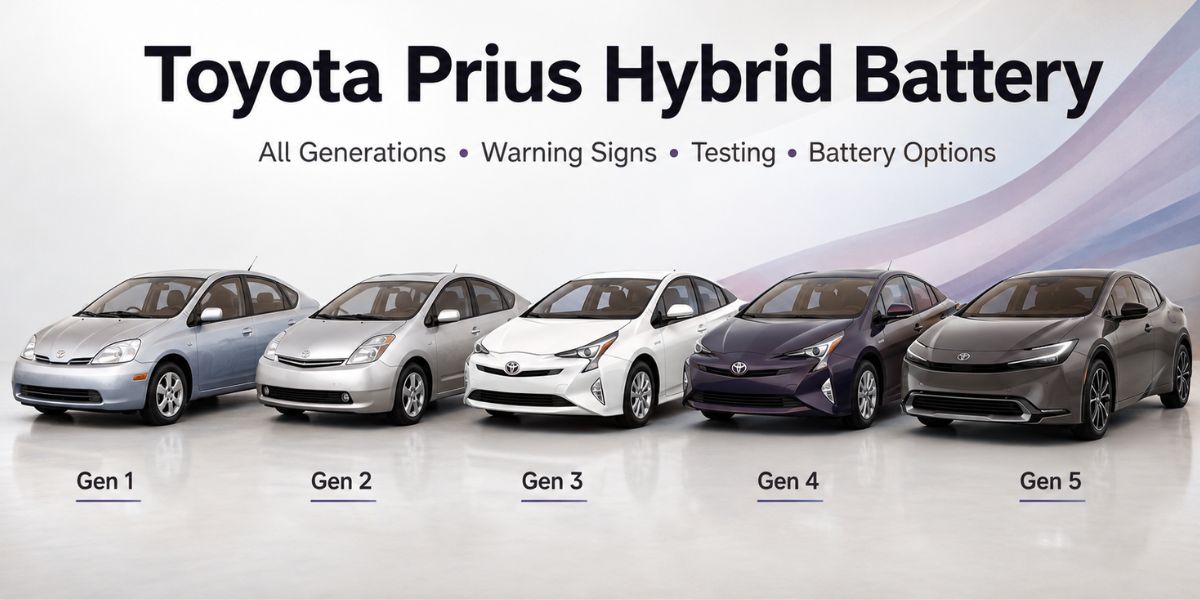
The Toyota Prius has been using hybrid battery technology since the launch of its first vehicle in 1997.
The Prius has had five main generations. Battery design and chemistry can vary by generation, market and spec of vehicle.
Toyota Prius Generations at a Glance
| Generation | Period | Battery |
| First generation | 1997–2003 | Nickel-metal hydride |
| Second generation | 2003–2009 | Nickel-metal hydride |
| Third generation | 2009–2015 | Nickel-metal hydride |
| Fourth generation | 2015–2022 | Nickel-metal hydride or Lithium-ion |
| Fifth generation | 2023–present | Later battery system |
These five standard Prius generations are identified as the 10, 20, 30, 50, and 60 series. Local model years can differ from the global introduction periods shown above.
Toyota Prius Generation 1 Hybrid Battery
Series: 10 Series
Global period: 1997–2003
Body style: Sedan
Battery type: Nickel-metal hydride
The first generation Toyota Prius was released in Japan in 1997. Unlike later generations of Prius it was a sedan. The first Toyota hybrid system was in it. Toyota Prius Gen 1 Hybrid Battery use Nickel Metal Hydride.
These first-generation cars are now much older than the Prius models. However, vehicle age alone does not confirm battery failure.
The battery, cooling system, related control systems, and stored diagnostic information need to be checked before making any decision to fix or replace anything.
Toyota Prius Generation 2 Hybrid Battery
Series: 20 Series
Global period: 2003–2009
Body style: Five-door liftback
Battery type: Nickel-metal hydride
The second-generation Prius was introduced in 2003.
This generation introduced the five-door liftback body style that became a defining feature of the Prius. It also used the more advanced Toyota Hybrid System II.
The second generation uses the same nickel-metal hydride hybrid battery as that of generation 1.
Because these vehicles can now have significant age and mileage, diagnostics are important. Battery condition should not be estimated from mileage alone.
Toyota Prius Generation 3 Hybrid Battery
Series: 30 Series
Global period: 2009–2015
Body style: Five-door liftback
Battery type: Nickel-metal hydride
The third-generation Prius was introduced in 2009.
Toyota changed the previous 1.5-litre hybrid system to a new system using a 1.8-litre engine. The standard third-generation Prius HEV used a high-output nickel-metal hydride hybrid battery.
This generation should not be confused with the Prius Plug-in based on the same general vehicle generation. The standard Prius HEV and the Prius Plug-in use different battery systems.
Toyota Prius Generation 4 Hybrid Battery
Series: 50 Series
Global period: 2015–2022
Body style: Five-door liftback
Battery type: market- and specification-dependent
The fourth-generation Prius was introduced in 2015.
It was the first Prius generation developed on Toyota’s TNGA platform. It also introduced an important change in hybrid battery selection.
Toyota has confirmed that fourth-generation Prius vehicles could use either nickel-metal hydride or lithium-ion batteries, depending on market and vehicle specification. The battery is placed beneath the rear seats.
This means the battery chemistry should not be identified from the generation alone.
The exact model year, market, grade and vehicle information should be checked before battery testing, parts selection or lifecycle work.
Toyota Prius Generation 5 Hybrid Battery
Series: 60 Series
Global introduction: 2023
Body style: Five-door liftback
Hybrid system: Fifth-generation Toyota hybrid system
Battery type: Confirm by market and specification
The fifth-generation Prius was introduced as a 60-series vehicle for 2023.
Toyota offers different fifth-generation HEV configurations in different markets. Toyota’s Japanese launch information includes both 1.8-litre and 2.0-litre HEV versions.
North American fifth-generation 2.0-litre Prius HEV models use a newly developed lithium-ion battery positioned beneath the rear seat. This should not automatically be treated as the specification for every fifth-generation Prius sold worldwide.
Before recording battery chemistry or compatibility, the exact market, grade, model year and vehicle identification information should be confirmed.
Possible Toyota Prius Hybrid Battery Warning Signs
Possible battery or hybrid-system warning signs may include:
- Hybrid system warning messages
- Master warning light
- Battery-related diagnostic trouble codes
- Unusual changes in the displayed battery charge
- Reduced electric assistance
- Changes in vehicle performance
- Increased fuel use
- Petrol engine running more frequently
- Battery cooling or temperature concerns
- Unusual battery cooling fan operation
These signs can have several causes.
They do not automatically confirm that the complete hybrid battery has failed. Other hybrid-system, cooling, electrical or control-system concerns may produce similar symptoms.
Toyota Prius Battery Testing and Diagnostics
Battery testing can help identify whether a concern relates to the hybrid battery or another part of the vehicle.
Testing may include:
- Reading stored diagnostic trouble codes
- Reviewing related or supporting fault codes
- Checking battery voltage observations
- Comparing battery behaviour where suitable
- Reviewing temperature observations
- Reviewing charging and discharging behaviour
- Looking for battery balance concerns
- Checking battery cooling information
- Checking communication between hybrid-system components
- Carrying out further inspection where required
The purpose of testing is to understand the condition observed at the time of assessment.
It should not be used to promise future battery life. It should also not be treated as a step-by-step repair procedure.
Relevant Toyota Prius Fault Codes
Toyota Prius battery diagnostics may involve fault codes such as P0A80 and P3000.
P0A80
P0A80 can be relevant when the hybrid control system identifies a battery deterioration concern.
The code should be assessed with supporting battery data and any related fault codes. It should not be used by itself to decide that the complete battery must be replaced.
P3000
P3000 can appear in connection with the hybrid battery control system.
Further diagnostic information is normally required to identify the underlying concern. P3000 alone does not provide a complete battery diagnosis.
The final page should contain short explanations only. Detailed code information should be placed on separate Fault Code Library pages and linked back to this Prius profile.
Toyota Prius Battery Health Report
A battery health report can organise the information collected during testing.
Depending on the testing process, it may include:
- Vehicle information
- Prius generation
- Model year
- Test date
- Diagnostic findings
- Battery observations
- Relevant fault codes
- Temperature observations
- Risk notes
- Recommended next steps
The report should clearly separate confirmed findings from possible concerns.
It should not present a possible battery issue as a confirmed diagnosis.
Toyota Prius Battery Health Certificate
A battery health certificate provides a shorter condition summary based on the assessment completed at that time.
It may be useful when a Prius is being:
- Purchased
- Sold
- Inspected
- Assessed by a workshop
- Evaluated by a dealer
- Reviewed as part of a vehicle fleet
A battery health certificate is not:
- A warranty
- A guarantee
- Proof of future battery life
- Proof that a future fault will not occur
The certificate should describe the battery condition observed during the assessment without making promises about future performance.
Possible Toyota Prius Hybrid Battery Decisions
The correct next step depends on the Prius generation, battery type, diagnostic findings and overall condition.
Further Diagnostics
More testing may be required when the initial information does not clearly identify the cause of the concern.
Battery Repair
Some battery concerns may be suitable for approved repair.
Suitability depends on the battery design, component condition and diagnostic findings.
Battery Reconditioning
Some Prius batteries may be considered for reconditioning where the battery condition and technical process make this appropriate.
Reconditioning is not suitable for every battery.
Hybrid Battery Remanufacturing
A suitable Prius battery may be assessed for an approved remanufacturing process.
Hybrid battery remanufacturing is a core part of Zentiq Energy’s battery lifecycle work. The process should include suitable testing, component assessment, quality control and safety procedures.
Battery Replacement
Battery replacement is best option when repair, reconditioning or remanufacturing is not technically or commercially suitable.
A replacement battery must be compatible with the exact Prius generation and specification.
A battery from one Prius generation should not be assumed to fit or operate correctly in another generation.
Zentiq Energy may support diagnostics, testing processes, reports, certificates, technical guidance, lifecycle decisions, partner enablement and remanufacturing systems. Capable workshops, franchise partners or other approved automotive businesses may carry out suitable battery work through their own operations.
Frequently Asked Questions
How many Toyota Prius generations are there?
There are five main standard Prius generations.
Toyota identifies them as the 10, 20, 30, 50 and 60 series.
Does all the Toyota Prius generations use the same battery?
No.
Battery design and chemistry can differ by generation, market and specification. Compatibility should always be checked against the exact vehicle.
Do all Toyota Prius models use nickel-metal hydride batteries?
No.
First three generations of standard Priuses used nickel metal hydride batteries. Depending on the market and specification the fourth generation could be powered by either nickel-metal hydride or lithium-ion batteries. Some fifth-generation HEV variants use lithium-ion batteries as well.
Does a warning light mean the complete Prius battery has failed?
No.
When a warning light is shown on the dashboard, it means there is some issue with battery. But that doesn’t always mean complete battery failure. Check fault codes and supporting battery information before coming to a conclusion.
Can a Toyota Prius hybrid battery be tested?
Yes.
The test may check fault codes, voltage readings, temperatures, charge and discharge characteristics, battery balance and other hybrid-system data.
Can a Toyota Prius battery be fixed?
Some battery problems may be eligible for authorised repairs.
It is contingent upon the generation, condition of the battery and diagnostic findings.
Can a Toyota Prius hybrid battery be remanufactured?
Some Prius hybrid batteries can be remanufactured through an approved process.
The first step should be to test the battery to see if remanufacturing is technically appropriate.
How long does a Toyota Prius hybrid battery last?
There is not a single lifespan for every Prius battery.
The condition of the battery may be affected by age, vehicle use, operating conditions, temperature, maintenance history and other factors. Testing gives more useful information than judging condition by age.
Does the Prius Plug-in use the same battery as the standard Prius?
No.
Prius Plug-in, Prius PHV, and Prius Prime models feature different battery systems and charging capabilities.
Toyota Prius Hybrid Battery Safety
Hybrid vehicles contain high-voltage electrical systems.
Hybrid and electric vehicle battery systems can involve dangerous high voltage. Testing, inspection and repair work should only be carried out by trained personnel using suitable equipment and safety procedures.
Do not open, dismantle or attempt to repair a Prius high-voltage battery without the required training, equipment and procedures.
Discuss Your Toyota Prius Battery
Zentiq Energy supports battery diagnostics, structured testing, battery health reporting and informed lifecycle decisions.
Support may also be available for approved hybrid battery repair, replacement, reconditioning and remanufacturing through Zentiq operations, franchise partners or other capable automotive businesses.