 Skip to content
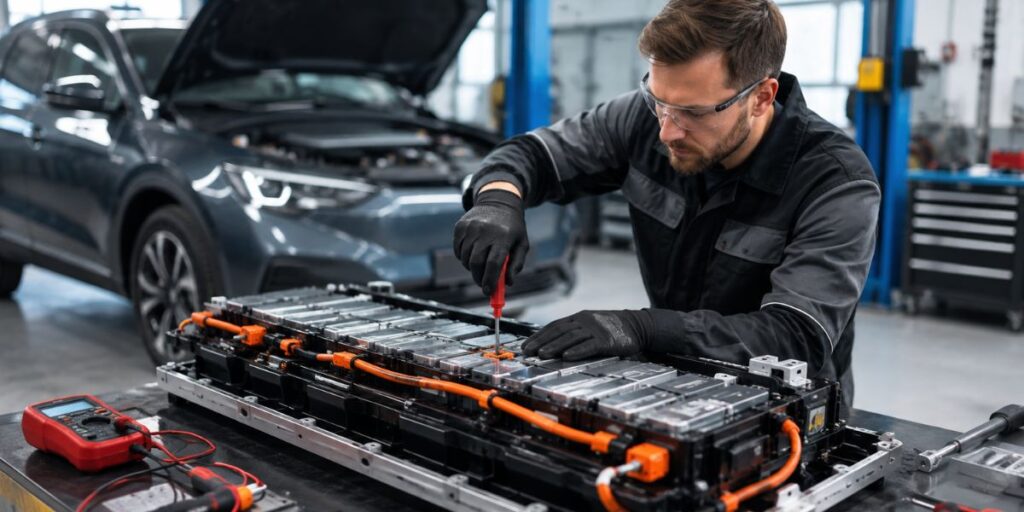
Hybrid vehicle batteries sometimes don’t need to go from vehicle use to complete replacement.
In some cases, a battery can enter a structured remanufacturing process.
Hybrid battery remanufacturing is not about just changing the one faulty part. It’s a complete process in which a battery is assessed, dismantled, tested, rebuilt using suitable components, balanced, checked, and verified before it goes back to a car again.
The goal is to give a battery new life using the standard procedures.
But every battery is not suitable for remanufacturing.
Battery condition, safety, chemistry, damage, component availability, vehicle application, and the expected result must all be considered first.
For this reason, proper diagnostics should come before remanufacturing begins.
What Does Hybrid Battery Remanufacturing Mean?
Hybrid battery remanufacturing is a structured process used to recover a battery pack that is suitable for further service.
The exact process can vary according to the battery design, vehicle model, chemistry, condition, equipment, and technical standards being followed.
In general, the battery is assessed at pack and component level.
Parts that do not meet the required condition are identified.
The working components and packs are kept while unsuitable components are either replaced or repaired using standard process.
After that, the battery is rebuilt, balanced, and tested to make sure it’s ready to hit the road again.
The important word is process.
Simply replacing one faulty part doesn’t mean that the hybrid battery is remanufactured.
A remanufacturing programme should use consistent testing, component selection, rebuilding, quality control, and final verification.
Why Do Hybrid Batteries Need Remanufacturing?
Hybrid batteries work through thousands of charge and discharge events during normal vehicle use.
With the passage of time their performance can change.
Battery deterioration does not always happen evenly across the complete pack.
One section may weaken faster than another.
Temperature differences, operating conditions, age, usage, cooling performance, and previous repairs can also affect battery condition.
Common signs that may lead to further battery assessment include:
- Hybrid system warning lights
- Reduced fuel economy
- Changes in electric assistance
- Rapid state-of-charge movement
- Battery cooling fan activity
- Reduced battery performance
- Diagnostic trouble codes
- Voltage differences between battery blocks
- Previous battery repair history
These signs do not automatically mean that remanufacturing is required.
They mean the battery should be properly tested.
A fault may come from the battery itself or from another part of the hybrid system.
How Does Hybrid Battery Remanufacturing Work?
A professional remanufacturing process normally has several stages.
The details can vary, but the principle is to understand the complete battery before deciding which components can continue in service.
Initial Battery Diagnostics
The process begins with diagnostics.
A technician may review:
- Diagnostic trouble codes
- Battery block or module voltages
- Temperature readings
- State-of-charge behaviour
- Battery management data
- Vehicle history
- Previous repair information
- Cooling system condition
- Performance under load
This first stage helps determine whether the battery is suitable for further assessment.
It can also identify problems outside the battery that may be contributing to the fault.
Zentiq Energy supports structured battery diagnostics and testing before major battery decisions are made.
Safety and Condition Assessment
Hybrid batteries carry high voltage and require specialized tools and trained technicians to handle safely. Before starting any work inspect the pack for physical damage, corrosion, water intrusion, thermal degradation, and loose or damaged connectors.
Severely damaged or compromised units must be decommissioned rather than remanufactured. Safety overrides component recovery in all instances.
Battery Disassembly
Where the battery is suitable and the approved process requires it, trained technicians can dismantle the battery in a controlled environment.
The battery contains more than individual cells or modules.
Depending on its design, it can include:
- Battery modules
- Busbars
- Sensors
- Wiring
- Contactors
- Cooling components
- Battery management components
- Cases and structural parts
Each area may need inspection.
The purpose is not simply to open the battery.
It is to understand the condition of the parts that make up the complete system.
Module and Component Testing
Individual battery sections can then be assessed.
Testing may look at areas such as:
- Voltage
- Capacity
- Internal resistance
- Charge behaviour
- Discharge behaviour
- Self-discharge
- Temperature behaviour
- Physical condition
One measurement alone may not be enough.
A module may show an acceptable voltage while still performing poorly under load.
This is why a structured testing process is important.
Component Selection
After testing, components can be separated according to condition.
Suitable components may remain within the remanufacturing process.
Components that fall outside the required limits should not simply be returned to the pack.
The aim is to create a battery with components that work together within the required performance range.
Component matching is particularly important.
A battery made from sections with very different characteristics may develop imbalance and performance problems.
Battery Balancing
Battery sections need to operate together.
Where appropriate for the battery type and approved process, balancing helps reduce differences between suitable modules or groups.
This can support more consistent charge and discharge behaviour.
Balancing should not be used to hide a weak component.
If a component does not meet the required standard, balancing alone does not turn it into a suitable component.
Reassembly
After suitable components have been selected and prepared, the battery can be rebuilt.
This stage may also involve inspecting or addressing approved supporting components where necessary.
Connections, sensors, cooling paths, electrical interfaces, and structural parts all require attention.
Good remanufacturing looks at the complete battery system rather than only the obvious failed section.
Final Testing and Verification
A rebuilt battery should be tested before it is considered ready for service.
Final checks may review:
- Battery voltage
- Module or block balance
- Diagnostic data
- Temperature readings
- Fault codes
- Charge behaviour
- Discharge behaviour
- Performance under appropriate test conditions
The battery should meet the defined process requirements before it is approved.
Once a remanufacturing process is complete, don’t consider it done and ready to use. Verification matters.
Is Battery Remanufacturing and Battery Repair the same?
No.
Sometimes these terms are used in same meaning, but they describe different levels of work.
Hybrid Battery Repair
A repair normally addresses a specific identified fault.
For example, a single component is repaired, a cooling fan is replaced, or electrical wires are repaired.
The work can be relatively targeted.
The complete battery may not go through a full remanufacturing programme.
Hybrid Battery Reconditioning
Reconditioning is the process of improving the condition or balance of a battery so that it can be used again.
It may involve testing, controlled cycling, balancing, and performance verification depending on the battery and process.
Reconditioning cannot correct every type of battery damage.
Hybrid Battery Remanufacturing
Remanufacturing is a wider process.
It normally involves deeper assessment, component-level testing, selection, rebuilding, balancing, and final quality checks.
The objective is to produce a battery that meets the requirements of the defined remanufacturing process.
Hybrid Battery Replacement
Replacement means removing the existing battery and installing another suitable battery.
That replacement could be new, remanufactured, or another approved battery depending on the vehicle and service provider.
The best solution will differ in each case.
What Makes a Good Remanufacturing Process?
Quality depends on much more than replacing weak battery modules.
Several areas are important.
Consistent Diagnostics
Structured checks should be followed rather than relying only on fault codes or visual judgement.
Consistent testing makes it easier to compare batteries and components.
Suitable Testing Equipment
Battery assessment requires equipment suitable for the battery type and work being completed.
Different tests provide different information.
The equipment must also be used by people who understand what the results mean.
Trained Technicians
It is very important to have required technical knowledge and safety tanning to work on high voltage batteries.
Training doesn’t means just dismantling the battery.
Technicians have deep understanding of diagnostics, battery behaviour, electrical safety, testing, component assessment, rebuilding, and verification.
Defined Component Standards
A remanufacturing process needs clear rules for deciding which components are suitable.
Using parts simply because they still function is not enough.
The components need to meet the requirements of the process.
Quality Control
The work should be documented.
Test results should be recorded where appropriate.
A repeatable quality-control process helps reduce differences between one remanufactured battery and another.
Final Verification
The battery should be checked after rebuilding.
Final verification helps confirm that the battery is operating as expected before it returns to the customer or partner.
Can Every Hybrid Battery Be Remanufactured?
No.
This is an important point.
Some batteries are not suitable candidates.
Reasons may include:
- Serious physical damage
- Fire damage
- Significant water exposure
- Severe internal deterioration
- Lack of suitable components
- Unsafe electrical condition
- Structural damage
- Battery chemistry or design limitations
- Poor economic viability
- Inability to achieve the required quality standard
Diagnostics should determine whether remanufacturing is a realistic option.
A responsible process should also be able to reject a battery.
Not every battery should be rebuilt.
What Are the Benefits of Hybrid Battery Remanufacturing?
When the battery is suitable and the work is completed correctly, remanufacturing can offer several benefits.
It Can Extend Battery Use
Suitable battery components may continue providing useful service instead of being removed from use too early.
This can extend the practical lifecycle of the battery.
It Can Provide Another Option Before New Replacement
A new battery may not always be the only suitable solution.
Depending on condition, vehicle value, availability, and local market conditions, a remanufactured battery may provide another route.
It Supports Better Use of Existing Components
A hybrid battery contains components that may not all deteriorate at the same rate.
Structured assessment can identify which parts remain suitable and which should no longer continue in service.
It Can Support a Circular Battery Model
Remanufacturing keeps suitable battery components in productive use for longer.
Components or battery pack that can’t be reused must be recycled or follow an end-of-life pathway.
This makes a more structured lifecycle. Instead of treating every battery fault as a reason to discard the complete pack.
What Are the Risks of Poor Battery Remanufacturing?
Not all battery rebuilding is the same.
Poor processes can create problems.
Possible issues include:
- Inadequate diagnostics
- Poorly matched battery modules
- Reuse of weak components
- Missing capacity tests
- Poor electrical connections
- Cooling problems
- Incomplete safety checks
- Limited quality control
- No final verification
- No clear record of work completed
If a standard procedure is not followed for rebuilding or it the problem is not detected properly it can become expensive.
It is very important for customers and businesses to understand what process was followed, what was tested, and what support is provided after the work.
How Is Remanufacturing Different From Installing a Used Battery?
A used battery has normally already operated in another vehicle.
Its history and internal condition may not always be fully known.
A remanufactured battery has gone through a defined assessment and rebuilding process.
That difference matters.
The value of remanufacturing comes from testing, selection, rebuilding, and quality control.
Simply moving a used battery from one vehicle to another is not the same thing.
Why Hybrid Battery Remanufacturing Matters for Automotive Businesses
Hybrid vehicles have been on roads around the world for many years.
As these vehicles age, more workshops, dealers, fleets, and vehicle owners need practical battery lifecycle options.
This creates a need for businesses that can do more than read fault codes.
The market requires:
- Battery diagnostics
- Health assessment
- Repair capability
- Battery replacement
- Reconditioning
- Remanufacturing
- Reporting
- Technical training
- Quality processes
For workshops, adding hybrid battery capability can create a specialist service area.
For larger automotive businesses, a structured remanufacturing operation can also support regional battery lifecycle services.
Zentiq Energy considers hybrid battery remanufacturing a core part of the wider hybrid battery industry opportunity.
Hybrid Battery Remanufacturing Within a Franchise Model
A workshop does not need to build a battery operation without structure.
A franchise model can provide established processes, training, equipment guidance, operating standards, diagnostics, reporting, and technical support.
Zentiq Energy offers different levels of battery business participation.
The EV Battery Diagnostic Franchise focuses primarily on battery testing, diagnostics, health reports, and certificates.
The Complete Franchise Package can include wider approved hybrid battery work such as:
- Battery testing
- Diagnostics
- Repair
- Replacement
- Reconditioning
- Hybrid battery remanufacturing
The exact activities depend on training, equipment, local regulations, technical capability, and the franchise agreement.
This distinction is important.
A diagnostic location does not automatically become a full remanufacturing centre.
Regional Remanufacturing and Global Expansion
Battery remanufacturing also has a geographical element.
Moving heavy high-voltage batteries over long distances can add cost, complexity, and logistics requirements.
A regional model can allow batteries to be tested and processed closer to the markets where they are used.
This may support:
- Local workshops
- Franchise partners
- Core battery collection
- Parts management
- Faster service
- Regional technical support
- Quality control
- Battery lifecycle management
Zentiq Energy’s global expansion strategy supports the development of battery service capability through suitable partners and regional operations.
What Should Happen Before Choosing Remanufacturing?
The first step should be diagnostics.
Do not decide that a battery needs remanufacturing simply because a warning light appears.
A structured assessment should answer several questions.
Is the Battery Actually Faulty?
Some hybrid system faults come from related vehicle systems rather than the battery itself.
The cause must be confirmed.
What Is the Condition of the Complete Battery?
One weak area does not explain the condition of every part of the pack.
The wider battery needs assessment.
Is the Battery Safe to Process?
Physical and electrical condition must be considered before internal battery work begins.
Is Remanufacturing Technically Suitable?
The battery design, chemistry, available components, condition, and required outcome all matter.
Does Remanufacturing Make Commercial Sense?
Vehicle value, customer requirements, local parts availability, warranty expectations, labour, and alternative battery options should also be considered.
The correct technical solution should also make sense for the individual vehicle and customer.
How Zentiq Energy Supports Hybrid Battery Remanufacturing
Zentiq Energy is a global battery health intelligence and hybrid battery remanufacturing company.
Hybrid battery remanufacturing is a core part of the Zentiq Energy business.
The approach connects battery diagnostics with practical lifecycle decisions.
Zentiq Energy supports suitable partners with areas such as:
- Structured battery diagnostics
- Battery assessment processes
- Remanufacturing procedures
- Technical training
- Equipment guidance
- Testing standards
- Quality-control processes
- Battery reports
- Technical support
- Partner enablement
- Battery lifecycle decisions
- Regional remanufacturing development
Depending on the business model, trained partners may complete approved battery repair, replacement, reconditioning, and remanufacturing through their own operation.
Zentiq Energy provides the structure, technology, training, processes, guidance, and support behind that work.
Remanufacturing Starts with Understanding the Battery
Hybrid battery remanufacturing is not simply replacing a failed module.
It is a structured battery lifecycle process.
The battery must first be diagnosed.
Its condition must be understood.
Components need to be tested and selected carefully.
The battery must be rebuilt according to the required process and verified before it returns to service.
When completed properly on a suitable battery, remanufacturing can extend useful battery life and provide another option alongside repair, reconditioning, and replacement.
The most important decision comes first.
Understand the battery before deciding what to do with it.
Explore Zentiq Energy’s hybrid battery remanufacturing and partnership opportunities to learn how diagnostics, training, processes, and regional battery services can support your business.
Frequently Asked Questions
Is a remanufactured hybrid battery the same as a new battery?
No.
A new battery is manufactured using new components.
A remanufactured battery uses an existing battery as the basis of a controlled assessment, component selection, rebuilding, and testing process.
The two products should not be described as identical.
Is hybrid battery remanufacturing the same as reconditioning?
No.
Reconditioning generally focuses on improving the performance or balance of a battery that remains suitable for further use.
Remanufacturing normally involves a wider process that can include dismantling, detailed component testing, selection, rebuilding, balancing, and final verification.
How do you know whether a hybrid battery can be remanufactured?
The decision should be based on diagnostics and physical assessment.
Technicians need to consider battery condition, damage, component performance, safety, battery design, parts availability, and whether the required quality level can realistically be achieved.
Does remanufacturing always mean replacing battery modules?
No.
The work required depends on the condition of the individual battery.
Testing should determine which components are suitable and which require action.
Can a workshop remanufacture hybrid batteries?
A suitably equipped workshop may be able to complete approved remanufacturing work if it has the correct training, equipment, safety procedures, processes, and technical support.
Local regulations and other applicable requirements must also be followed.
