
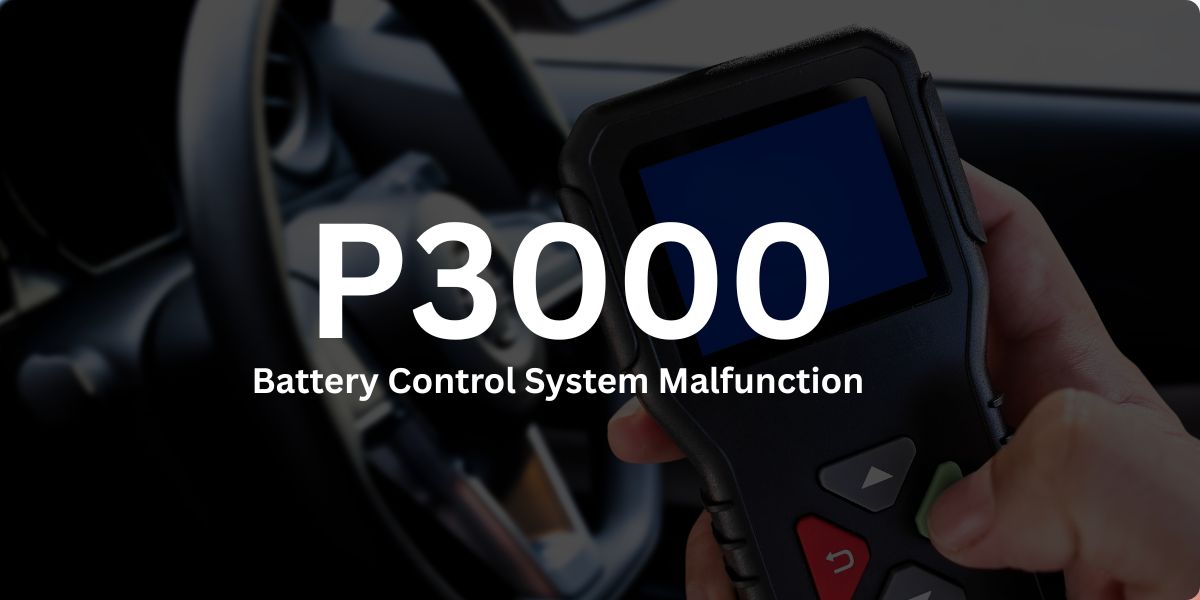
The P3000 fault code is associated with the hybrid battery and hybrid control system on relevant Toyota hybrid vehicles.
It is commonly described as Battery Control System Malfunction.
P3000 does not identify one single battery problem.
The meaning depends on the vehicle, the accompanying diagnostic codes and, where available, the additional information code stored with P3000.
Further diagnostics and testing are required before deciding whether the vehicle needs battery repair, reconditioning, remanufacturing, replacement or attention to another part of the hybrid system.
What Does the P3000 Code Mean?
P3000 indicates that the hybrid control system has detected information relating to the high-voltage battery or battery control system.
Toyota repair information lists P3000 as Battery Control System Malfunction and uses additional information codes such as 123, 125, 388, 389 and 603 to provide more detail about the detected condition.
This makes the additional diagnostic information particularly important.
The main P3000 code alone should not be used to decide that the complete hybrid battery has failed.
Why the P3000 Information Code Matters
A diagnostic scan may provide P3000 together with an additional information or INF code.
This extra information can significantly change how the fault should be investigated.
For example, Toyota explains that P3000/123 can be stored automatically when the HV Battery ECU detects another fault.
In this situation, Toyota advises technicians to diagnose the underlying HV Battery ECU diagnostic codes rather than treating P3000/123 itself as the primary fault.
Other P3000 information codes require their own diagnostic process.
Toyota documentation identifies information codes including:
- P3000-123
- P3000-125
- P3000-388
- P3000-389
- P3000-603
The exact meaning and diagnostic procedure depend on the information code and vehicle application.
Which System Is Connected to P3000?
P3000 is connected with the vehicle’s hybrid battery control and hybrid control systems.
These systems exchange information about the operation and condition of the high-voltage battery.
When the battery ECU detects certain abnormal conditions, information may be communicated to the hybrid control ECU and P3000 may be stored.
For P3000/123 specifically, Toyota states that the code does not by itself indicate a malfunction of the HV Control ECU.
This is why all stored codes need to be reviewed together.
Possible Symptoms of P3000 Fault Code
Symptoms can vary depending on the underlying fault and vehicle.
Possible signs may include:
- Hybrid system warning light
- Check engine light
- Hybrid battery warning message
- Reduced hybrid-system operation
- Limited vehicle performance
- Difficulty entering normal READY operation
- Other hybrid or battery-related warning codes
Toyota repair information lists limited driving as a possible fail-safe condition for several P3000 information codes.
Not every vehicle will show the same symptoms.
The symptoms may also be caused by the underlying fault that triggered P3000 rather than P3000 itself.
Possible Causes of a P3000 Fault Code
There is no single cause that applies to every P3000 fault.
Depending on the information code and vehicle, possible conditions can include:
- Another fault detected by the HV Battery ECU
- Low hybrid battery state of charge
- Significant reduction in hybrid battery voltage
- Hybrid battery system problems
- Hybrid control system problems
- The vehicle being left in Neutral for an extended period
- The vehicle running out of fuel
- Engine-related problems affecting hybrid battery charging
- Hybrid transaxle-related problems
- Other faults preventing the hybrid battery from maintaining its expected charge
Toyota’s repair information for P3000-388 states that battery state of charge can fall because the vehicle has been left in Neutral, has run out of fuel or has another hybrid control system problem.
Toyota documentation for P3000-389 also describes a significant drop in high-voltage battery voltage and identifies the HV battery, hybrid control system, engine and hybrid transaxle among areas that may require investigation.
The exact cause must therefore be confirmed through diagnostics.
Does P3000 Mean the Hybrid Battery Has Failed?
No. Not by itself.
P3000 is not enough to confirm complete hybrid battery failure.
This is particularly clear with P3000/123.
Toyota explains that this information code can be stored because the HV Battery ECU has detected another diagnostic trouble code. Toyota’s guidance is to diagnose those battery ECU codes instead.
A P3000 code may ultimately be associated with a battery problem, but other causes are possible.
The complete diagnostic information needs to be reviewed first.
How Should a P3000 Fault Be Diagnosed?
Diagnosis should begin with a complete scan of the vehicle.
Depending on the vehicle and stored information, assessment may involve:
- Reading all stored diagnostic trouble codes
- Identifying the P3000 information code
- Checking HV Battery ECU codes
- Reviewing related hybrid control codes
- Reviewing hybrid battery state of charge
- Reviewing relevant battery voltage data
- Checking whether the engine is operating correctly
- Reviewing whether the hybrid battery is charging normally
- Investigating other supporting faults where required
For P3000/123, Toyota specifically advises diagnosing the HV Battery ECU codes rather than attempting to diagnose P3000/123 as an isolated fault.
For P3000-388 and P3000-389, Toyota’s diagnostic information also instructs technicians to review other stored codes first.
This is why a basic code reader showing only P3000 may not provide enough information for an accurate diagnosis.
P3000 and Low Hybrid Battery Charge
Some versions of P3000 can be associated with a significant reduction in hybrid battery state of charge.
This does not automatically mean that the battery itself is defective.
Toyota documents that P3000-388 can occur when battery state of charge falls following conditions such as leaving the vehicle in Neutral or running out of fuel.
P3000-389 can also be associated with a large drop in high-voltage battery voltage.
The reason for the low battery charge or voltage must therefore be identified.
Why Other Fault Codes Are Important
P3000 is a good example of why a vehicle should not be diagnosed from one code alone.
Additional battery or hybrid-system codes may contain the information needed to identify the actual fault.
For P3000/123, Toyota states that the underlying HV Battery ECU codes should be diagnosed.
If another battery code such as P0A80 is also present, that code should be assessed separately rather than assuming P3000 and P0A80 mean exactly the same thing.
Related guide:
P0A80 Fault Code – Replace Hybrid Battery Pack
Vehicles That May Display P3000
P3000 is used in relevant Toyota hybrid diagnostic systems.
A Toyota technical bulletin specifically confirms P3000/123 on 2001–2009 Toyota Prius models.
Other Toyota hybrid vehicles and generations may use P3000 with different information codes.
However, the exact code definition, information code and diagnostic procedure should always be checked against the correct manufacturer information for the specific vehicle.
Zentiq Energy should only add individual vehicle models to this section after their P3000 application has been technically verified.
What Happens After a P3000 Diagnosis?
The next step depends on the underlying fault.
Possible outcomes can include:
Further Diagnostics
Additional codes and battery data may need to be reviewed before any repair decision is made.
Correcting a Related Vehicle Problem
The cause may involve another part of the hybrid system, engine operation or another condition affecting battery charging.
Battery System Repair
If testing identifies a repairable battery-system fault, appropriate repair may be considered.
Battery Reconditioning
Reconditioning may be an option for suitable batteries where diagnostic results and battery condition support it.
Hybrid Battery Remanufacturing
Where appropriate, hybrid battery remanufacturing may form part of the battery lifecycle decision.
Hybrid Battery Replacement
Replacement may be appropriate where testing confirms that it is the correct solution.
No one option should be selected from the P3000 code alone.
P3000 and Hybrid Battery Remanufacturing
P3000 does not automatically mean that a hybrid battery should be remanufactured.
The underlying cause first needs to be identified.
If detailed testing confirms deterioration or another suitable battery condition, hybrid battery remanufacturing may be considered as part of the battery lifecycle assessment.
In other situations, another repair, reconditioning, replacement or correction elsewhere in the vehicle may be more appropriate.
Zentiq Energy supports structured hybrid battery testing, diagnostics, battery health assessment and lifecycle decision-making alongside hybrid battery remanufacturing.
Approved battery work may also be carried out by trained franchise partners, workshops and other suitable automotive businesses depending on equipment, training, location and partnership scope.
P3000 Frequently Asked Questions
What does P3000 mean?
P3000 is commonly described in relevant Toyota hybrid repair information as Battery Control System Malfunction.
The exact meaning depends on the additional information code and other diagnostic trouble codes stored in the vehicle.
Does P3000 mean I need a new hybrid battery?
No.
P3000 alone does not confirm that the complete hybrid battery needs replacing.
Further diagnostics are required.
What is P3000-123?
P3000/123 can be stored by the hybrid control ECU when the HV Battery ECU detects another diagnostic trouble code.
Toyota advises diagnosing the underlying HV Battery ECU codes rather than diagnosing P3000/123 itself.
What is P3000-388?
Toyota repair information associates P3000-388 with a significant drop in hybrid battery state of charge.
Possible conditions include leaving the vehicle in Neutral, running out of fuel or another hybrid control system problem.
What is P3000-389?
P3000-389 can be associated with a significant drop in high-voltage battery voltage.
The battery and other parts of the hybrid system may require further investigation.
Can P3000 appear with other fault codes?
Yes.
Other diagnostic codes can be particularly important because they may identify the underlying condition responsible for P3000.
For P3000/123, Toyota specifically instructs technicians to diagnose the accompanying HV Battery ECU codes.
Can P3000 be cleared?
A stored diagnostic code may be cleared after appropriate diagnosis or repair, but clearing the code does not correct the underlying condition.
If the problem remains, the fault may return.
Can a P3000 battery be repaired?
Possibly.
Whether battery repair is suitable depends on the actual fault, battery condition, vehicle application and diagnostic results.
Can the battery be reconditioned or remanufactured?
Possibly.
Reconditioning or remanufacturing should only be considered after the battery has been properly tested and the underlying cause of P3000 has been identified.
Hybrid Battery Safety
Hybrid and electric vehicle battery systems can involve dangerous high voltage.
Testing, inspection and repair work should only be carried out by trained personnel using suitable equipment and safety procedures.
Do not open, disconnect or work inside a high-voltage battery system without the appropriate training and equipment.
Need Help With a P3000 Fault Code?
P3000 is a starting point for diagnosis rather than a complete answer.
Zentiq Energy supports hybrid and EV battery diagnostics, battery testing, battery health assessment and battery lifecycle decision-making.
Depending on the diagnostic results, suitable next steps may include further testing, repair, reconditioning, replacement or hybrid battery remanufacturing.
Discuss Your P3000 Fault Code
Share your vehicle details, P3000 information code and any additional diagnostic codes with Zentiq Energy to discuss the next suitable step.