 Skip to content
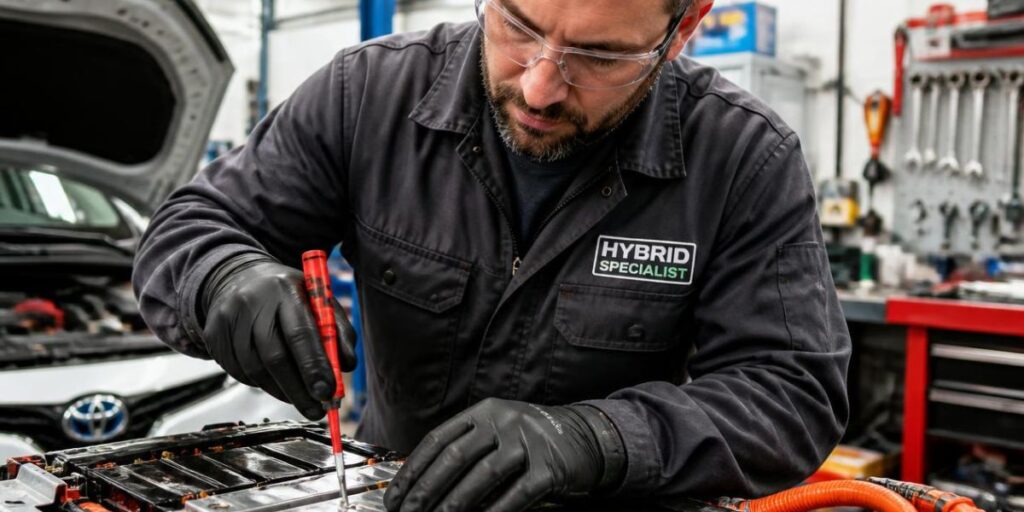
Hybrid batteries usually work in the background when the vehicle is driven. Many of the drivers don’t think about the battery until something happen.
A warning light may appear. Fuel economy may drop. The engine may run more often. The battery charge level may rise and fall much faster than before.
These can be signs of a hybrid battery problem. But they do not always mean the complete battery has failed.
Hybrid cars have many systems that are interconnected. A cooling problem, a sensor malfunction, an electrical problem or another part can sometimes cause similar symptoms.
What are the signs When a Hybrid Battery Starts to Fail?
A hybrid battery contains multiple cells or modules working together.
Over time, their condition can change.
Capacity may reduce. Internal resistance may increase. Individual sections may begin behaving differently from the rest of the pack.
When these differences become large enough, the vehicle’s battery management system may detect a problem.
The driver may then notice changes in performance or see a warning message.
Battery deterioration can happen gradually.
In other cases, a problem may appear suddenly.
The symptoms depend on the vehicle, battery design, fault, and operating conditions.
Common Hybrid Battery Failure Symptoms
There is no single symptom that confirms hybrid battery failure.
Several signs may appear together.
Hybrid System Warning Light
A dashboard warning is often the most obvious sign. Depending on the vehicle, this may appear as:
- Check hybrid system warning
- Hybrid system malfunction
- Battery warning
- Check engine light
- Master warning light
A warning means the vehicle has detected something that requires investigation.
It does not automatically mean the complete hybrid battery needs replacement.
The vehicle should be scanned for diagnostic trouble codes before a decision is made.
A proper battery diagnostic assessment can help determine whether the fault comes from the battery or another system.
Reduced Fuel Economy
A good hybrid car utilise both the electric motor and petrol or diesel engine together to improve fuel economy.
If there is a problem with hybrid battery the car is more likely to depend on combustion engine. This can increase fuel use.
You may notice that the vehicle:
- Uses more fuel than before
- Runs the engine more frequently
- Uses electric assistance for shorter periods
- Struggles to maintain normal hybrid operation
Fuel economy is effected by many reasons. Tyres, driving style, weather, engine condition, brakes, and other factors can all have an effect.
A reduction in fuel economy alone does not prove the battery is failing. However, it may justify further checks when combined with other symptoms.
Battery Charge Level Changes Quickly
Most of the hybrid cars shows the battery charge level on the dashboard. A battery in good condition normally charges and discharges within the expected operating range. A weak battery may appear to move between high and low charge levels unusually quickly.
For example, the display may show a high charge level and then fall rapidly after a short period of electric assistance.
It may then recharge quickly again. This can happen when the battery has lost usable capacity. The battery may still charge. It simply cannot hold or deliver as much usable energy as expected.
The Engine Runs More Often
A hybrid car depends on its battery to support the electric motor. If the hybrid battery fail to provided the expected power to the motor the engine then run more frequently.
This may be noticeable during:
- Low-speed driving
- Light acceleration
- Traffic
- Short journeys
- Situations where the vehicle previously used electric power
The engine running more often is not always a battery fault.
Temperature, heating or air conditioning demand, state of charge, and vehicle operating conditions can also affect engine use.
The important point is whether the vehicle’s behaviour has changed significantly from normal.
Reduced Electric Assistance
A weakening battery may provide less assistance during acceleration. The vehicle may behave different when pulling away or climbing a hill.
In some cases, the engine may work harder because the electric motor is receiving less support from the battery.
Drivers may describe this as:
- Reduced performance
- Slower response
- Less electric boost
- Engine revving more than expected
These symptoms should be investigated rather than used as proof of battery failure.
Hybrid system performance depends on several components working together.
Battery Cooling Fan Runs Frequently
When hybrid batteries are used, they get hot.
Many hybrid cars use cooling components such as fans to control the battery temperature.
The cooling fan might run more often or faster if the battery is working harder than usual or developing temperature differences.
You may hear a fan noise coming from the back or side of the vehicle. A noisy cooling fan may also indicate a cooling-system problem.
For example:
- The air intake may be blocked
- The fan may be dirty
- Airflow may be restricted
- A temperature sensor may have a problem
The cooling system should therefore be inspected as part of the diagnosis.
Changes in Battery Temperature
The difference in temperature within a battery provides useful information about its condition.
A weak module may behave differently under load and generate more heat than surrounding sections. Poor cooling can also create high battery temperatures.
Technicians may compare temperature sensor readings during testing. If a technician found unusual reading that doesn’t always means the complete battery has failed. The sensor, cooling system, vehicle conditions, and battery data all need to be considered together.
Loss of Power or Reduced Performance
Some hybrid battery problems can lead to noticeable reductions in vehicle performance.
The vehicle may limit available power to protect the battery or hybrid system.
This can sometimes result in:
- Weak acceleration
- Reduced electric motor assistance
- Limited vehicle performance
- A protective or reduced-power mode
If the vehicle suddenly loses significant power or displays serious warnings, it should be assessed promptly.
Continuing to drive without understanding the problem may cause further issues.
What Causes Hybrid Battery Failure?
Hybrid battery deterioration does not usually come from one single cause.
Several factors can affect battery life.
Age and Normal Use
Battery components naturally change over time.
Repeated charging and discharging gradually affects capacity and resistance.
The rate of change varies between vehicles.
Mileage alone does not tell the full story.
Heat
High temperatures can increase battery stress.
A battery cooling problem can make this worse.
Keeping battery cooling systems clean and operating correctly is important.
Differences Between Modules
Battery modules do not always age at exactly the same rate.
One weak section can begin to behave differently from the others.
This may create voltage imbalance or trigger diagnostic trouble codes.
Previous Battery Work
A battery that has already been repaired may contain components with different ages, capacities, or operating characteristics.
The quality of previous work can affect future battery performance.
Electrical or Cooling Problems
Not every apparent battery failure starts with the battery cells.
Problems involving wiring, sensors, cooling components, control systems, connectors, or related hybrid components can affect battery operation.
This is another reason diagnostics should come first.
Can You Drive With a Failing Hybrid Battery?
That depends on the fault.
Some vehicles may continue driving with a battery warning.
Others may reduce power or eventually become unable to operate normally.
The fact that a vehicle still drives does not mean the problem should be ignored.
A developing fault may become worse.
It may also be difficult to know whether the problem is limited to battery deterioration or involves an electrical or safety concern.
If a hybrid warning appears or the vehicle’s behaviour changes significantly, professional testing is the safer next step.
How Is Hybrid Battery Failure Diagnosed?
Good diagnosis involves more than reading one fault code.
A structured assessment looks at the battery as a complete system.
Diagnostic Trouble Codes
The vehicle is normally scanned first.
Codes can identify the system or area where a problem has been detected.
They help guide further testing.
They should not always be treated as the final diagnosis.
Battery Block or Module Voltage
Technicians may compare voltage readings between different sections of the battery.
A larger-than-expected difference may indicate imbalance or a weak section.
Readings may also need to be checked under load.
State-of-Charge Behaviour
How quickly the battery charges and discharges can provide useful information.
Unusual movement can indicate reduced usable capacity.
Internal Resistance
Internal resistance can help identify modules that behave differently from others.
Higher resistance can affect power delivery and create additional heat.
Temperature Data
Battery temperature readings can help identify cooling issues or abnormal behaviour within the pack.
Performance Under Load
Some battery problems only become clear when the vehicle requests power.
Testing under appropriate conditions can show how the battery responds during acceleration, charging, or other operating situations.
Zentiq Energy’s Battery Health Intelligence approach brings battery data and diagnostic findings together to support clearer decisions.
Does a Warning Code Mean the Battery Needs Replacement?
No.
A code may identify a battery-related problem.
Further testing should confirm what is actually happening.
For example, diagnostics may identify:
- One weak battery section
- Significant overall battery deterioration
- A cooling problem
- A sensor issue
- An electrical connection problem
- Another hybrid system fault
The correct response depends on the findings.
Replacing the complete battery before confirming the problem can lead to unnecessary cost.
What Happens After a Hybrid Battery Is Tested?
Once the battery condition is understood, several options may be available.
The right option depends on the individual battery.
Continue Using the Battery
If testing shows that the battery is operating within an acceptable range, no immediate battery work may be required.
The vehicle can continue in service.
Monitoring may still be recommended.
Further Diagnostics
Sometimes the first assessment identifies an issue that requires more detailed investigation.
Additional testing may be needed before any repair decision is made.
Battery Repair
A repair may be possible when the problem is clearly identified and the battery is otherwise suitable.
Repair should address the confirmed fault rather than simply replacing components without proper testing.
Battery Reconditioning
Some batteries may be suitable for reconditioning.
This can involve controlled testing, cycling, balancing, and performance checks.
It is not suitable for every battery.
Hybrid Battery Remanufacturing
Remanufacturing involves a wider process.
A suitable battery may be dismantled, tested at component level, rebuilt using suitable components, balanced, and verified.
This should follow a defined technical and quality-control process.
Battery Replacement
Replacement may be the better option when the battery is badly deteriorated, damaged, unsafe, or not practical to repair or remanufacture.
The decision should be based on condition, vehicle value, cost, availability, and expected outcome.
Read more about Battery Lifecycle Solutions and how diagnostics can support the choice between different battery options.
Why Testing Before Repair Matters
A warning light tells you there is a problem.
It does not always tell you the correct solution.
Without proper testing, a workshop may:
- Replace parts unnecessarily
- Miss the real cause
- Repair one module while ignoring wider battery deterioration
- Recommend a full replacement too early
- Fail to identify a cooling or electrical issue
Testing gives the technician information to work from.
It also gives the customer a clearer explanation of why a particular option is being recommended.
The order should be simple.
Test first. Understand the battery. Then decide what work is required.
How Zentiq Energy Supports Hybrid Battery Decisions
Zentiq Energy is a global battery health intelligence and hybrid battery remanufacturing company.
We support automotive businesses with structured battery assessment and lifecycle decision-making.
This can include:
- Hybrid battery testing
- Battery diagnostics
- Battery health assessment
- Battery data interpretation
- Reports and certificates
- Repair decision support
- Replacement guidance
- Reconditioning processes
- Hybrid battery remanufacturing
- Technical training
- Partner support
Capable workshops and partners may perform approved repair, replacement, reconditioning, or remanufacturing themselves.
The Complete Franchise Package supports wider hybrid battery work, subject to training, equipment, local regulations, technical capability, and the franchise agreement.
Do Not Ignore Changes in Hybrid Battery Behaviour
Hybrid battery problems do not always begin with complete failure.
The early signs can be smaller.
Fuel economy may change.
The charge indicator may move more quickly.
The engine may run more often.
The cooling fan may become noticeable.
A warning may eventually appear.
None of these signs should be used alone to decide that the battery needs replacement.
They should be treated as a reason to investigate.
Proper battery diagnostics can show what is happening and which options make sense.
Start with a proper battery diagnostic assessment before choosing a repair, replacement, reconditioning, or remanufacturing path.
Frequently Asked Questions
What is the most common sign of hybrid battery failure?
A hybrid system or battery warning light is one of the clearest signs that a problem has been detected.
Changes in fuel economy, charge behaviour, electric assistance, and cooling fan operation may also occur.
Does poor fuel economy mean my hybrid battery is failing?
Not necessarily.
Fuel economy can be affected by driving conditions, tyres, engine condition, weather, brakes, and many other factors.
Battery testing is needed if poor fuel economy appears alongside other hybrid battery symptoms.
Can one weak module cause hybrid battery problems?
Yes.
A weak module or battery section can create imbalance and affect the performance of the pack.
Testing is required to understand whether the problem is limited or whether wider battery deterioration is present.
Can a hybrid battery be repaired instead of replaced?
Sometimes.
The correct option depends on the fault and overall battery condition.
Testing should come before choosing repair, replacement, reconditioning, or remanufacturing.
How do I know whether my hybrid battery is actually failing?
A professional diagnostic assessment is the best way to confirm battery condition.
Fault codes, voltage behaviour, temperature, internal resistance, state-of-charge movement, and performance data may all be used as part of the assessment.
