Skip to content
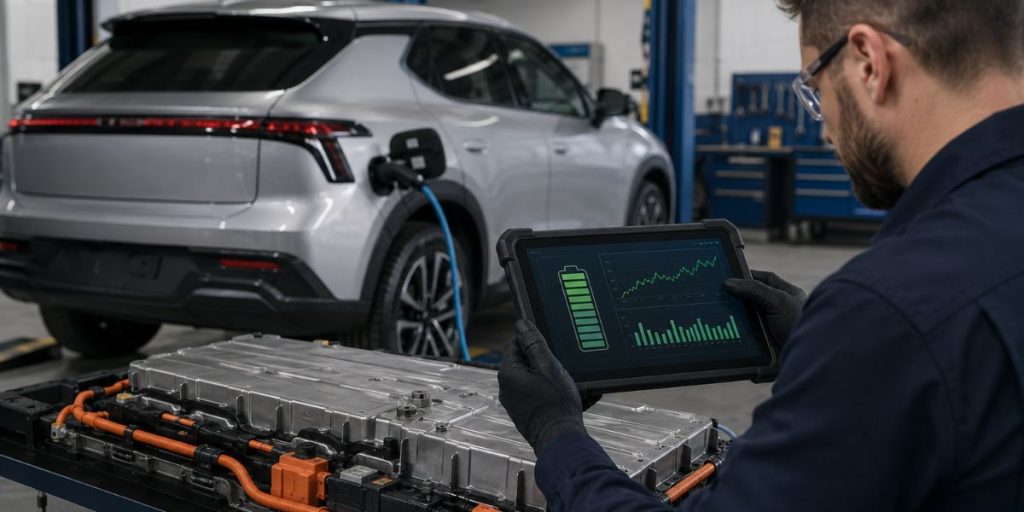
Electric vehicle batteries are supposed to last for years. Over time electric vehicle batteries can start to lose their performance. This happens because of age, mileage, charging style and extreme weather conditions.
A warning light or fall in driving range may raise concern. But neither explains the full condition of the battery.
EV battery testing looks at battery data, performance, fault history, temperature, voltage behaviour, and related vehicle systems. It helps identify what is happening before a major decision is made.
What Is EV Battery Testing?
EV battery testing is a structured assessment of the high-voltage battery and the systems that support it.
It is more than connecting a basic code reader.
The technician may review information from the battery management system, charging system, cooling system, and individual battery sections. The exact procedure will depend on the vehicle, the type of battery, the equipment available and the reason for the test.
Some checks can be done with the battery still in the vehicle. More detailed work may require specialist equipment and controlled workshop procedures.
High-voltage batteries are a significant electrical and thermal hazard.
Why Is Battery Testing Important?
The battery is one of the most important components of an electric car.
Replacing it without proper evidence can create unnecessary cost. Continuing to use a battery with an unidentified problem may also affect performance, reliability, or safety.
Testing helps determine whether the battery is operating normally, whether usable capacity has reduced, and whether a fault sits inside the battery or another vehicle system. It also helps identify the most suitable next step.
Battery health can be difficult to measure during normal vehicle use. Detailed laboratory capacity tests may take considerable time, so workshop assessments often combine vehicle data, rapid measurements, and technical judgement. Research from NREL also notes that battery diagnosis during real-world operation is harder than controlled laboratory testing.
Learn more about Zentiq Energy’s battery diagnostics and testing services.
How EV Battery Testing Works
The process varies between vehicles. However, a structured battery test will usually include several common stages.
1. Vehicle and Battery History
The technician will first review the vehicle history and the reason for testing.
This may include:
- Vehicle age and mileage
- Charging habits
- Previous battery work
- Warning messages
- Reduced driving range
- Loss of power
- Charging problems
- Accident or water exposure
This information helps guide the assessment. A sudden warning message may require a different approach from a gradual reduction in range.
2. Safety and Visual Checks
Before doing any in-depth testing, look at the vehicle for any obvious problems.
The inspection may include the battery case, high voltage cables, cooling components, protection under the vehicle and charging equipment. Look for signs of impact damage, corrosion, water ingress, overheating or damaged wiring.
If a battery has been accidentally damaged, flooded, fire-damaged or severely overheated, it may need to be isolated and specialist safety procedures used rather than a routine health check.
3. Full Diagnostic Scan
A full vehicle diagnostic scan checks stored and active fault codes across the battery management system and related control units.
Fault codes may indicate:
- Voltage imbalance
- Temperature problems
- Cooling faults
- Charging issues
- Communication errors
- Isolation concerns
- Battery performance problems
A fault code is a just the start and is not final diagnosis.
The technician still has to look at the live data, operating conditions, and potential causes before advising any work.
4. State of Charge and Live Data
State of charge shows how much energy is currently available.
It should not be confused with state of health.
A battery may be fully charged but have less usable energy than it had when it was new.
The technician can check voltage, current, temperature, charge movement and readings from different cells, modules or blocks of batteries.
Small differences may be normal. Larger or repeated differences can suggest imbalance, weakness, cooling problems, sensor faults, or localised battery stress.
Zentiq Energy’s battery health intelligence helps turn technical battery data into information that businesses can use.
5. Performance or Load Testing
Some battery problems only appear when the vehicle requests power.
A performance test may review voltage, current, temperature, and state of charge during acceleration, charging, regenerative braking, or another controlled load. A weak cell group may look acceptable while stationary but fall more quickly under load.
Controlled pulse tests can also help assess resistance and capacity.
However, rapid diagnostics do not reveal every form of ageing or every possible safety concern. Recent NREL research found that short pulse testing can help separate higher and lower-capacity cells, but it is not enough on its own to predict remaining useful life or every safety risk.
6. State of Health Assessment
State of health is an estimate of the battery’s present condition compared with an expected reference point.
It may consider:
- Available capacity
- Internal resistance
- Power capability
- Cell balance
- Temperature behaviour
- Vehicle-related battery data
A single test can’t work for every battery.
The outcome can be affected by chemistry, design, software, age, operating history and test conditions. A state-of-health percentage should therefore be read alongside the wider diagnostic findings.
A clear report should explain what the figure represents and any limits that apply.
7. Supporting System Checks
Not all range or charging problems start inside the high voltage battery.
The assessment may also cover charging equipment, cooling components, sensors, high voltage contactors, isolation monitoring, vehicle software and the 12 volt battery.
A weak 12-volt battery, charging fault, or cooling problem can sometimes create symptoms that appear to be a traction battery failure.
Checking related systems will reduce the chance of replacing the wrong part.
8. Battery Report and Certificate
After testing, the findings should be organised into a clear report.
The report may include:
- Vehicle and battery details
- Test conditions
- Fault codes
- State-of-charge information
- State-of-health estimate
- Voltage and temperature findings
- Performance observations
- Areas needing further inspection
- Recommended next step
A battery health certificate may also be issued when the testing process and available data support it.
The certificate records battery condition at the time of testing. It should not be treated as a guarantee that the battery will never develop a future fault.
What Can an EV Battery Test Reveal?
A systematic test can help detect decreased usable capacity, weak or unbalanced sections of the battery, increased resistance, unusual voltage movement, temperature differences, cooling concerns, charging faults, stored error codes or communication problems.
It could also show that the battery is operating in its expected range. This can avoid unnecessary replacement and provide a baseline for future monitoring.
EV Battery Testing and Hybrid Battery Testing
Testing is important for electric and hybrid vehicles, but the way it is done will be different.
Almost every electric vehicle use lithium-ion batteries. On the other hand hybrid batteries use lithium-ion or nickel-metal hydride batteries, depending on the model and year.
Electric, plug-in hybrid and hybrid vehicles all depend on battery energy storage, but the types and systems are different, according to the US Department of Energy.
A hybrid battery is often smaller than a full EV battery. It is also able to perform frequent charge/discharge cycles as the vehicle operates between engine and electric assistance.
Hybrid diagnostics may concentrate more on battery block voltage, module balance, cooling airflow, charge movement and behaviour on acceleration.
If a hybrid battery fault is found, there are several options like repair, replacement, reconditioning, or remanufacturing. The right decision depends on condition, safety, cost, value of vehicle, availability of parts, and expected result.
When Should a Battery Be Tested?
Battery testing may be useful when:
- A battery or hybrid system warning appears
- Driving range falls unexpectedly
- Charging becomes slow or inconsistent
- The vehicle loses power
- A used EV or hybrid is being bought or sold
- A dealer is assessing a trade-in
- A fleet is planning maintenance
- Battery work has recently been completed
- An insurance company, auction, or assessor needs condition information
Testing can also help with routine monitoring, allowing you to compare test results over time instead of waiting for a major problem to occur.
What Happens After Testing?
Testing does not necessarily mean the battery needs replacement.
The result may lead to one of several decisions.
Continue using the battery.No immediate work may be needed.
Monitor the battery. Early changes may justify another test later.
Complete further diagnostics. The first test may identify an area that needs deeper inspection.
Repair a specific fault. A trained provider may repair an approved component or related system where suitable.
Recondition the battery. Some hybrid batteries may be suitable for controlled testing, balancing, and reconditioning.
Remanufacture the battery. This process includes dismantling, detailed testing, replacement of unsuitable components, rebuilding, balancing, and final verification.
Replace the battery. Replacement is only the best option when the battery is not safe, badly damaged, unsuitable for further approved work, or no longer practical to restore.
Advanced diagnostics helps in deciding whether batteries or battery components are suitable for reuse, refurbishment, or recycling instead of sending every unit directly to disposal.
Read more about battery lifecycle solutions and how test results can support the next decision.
Choosing a Battery Testing Provider
Look for a provider with suitable training, safety procedures, vehicle coverage, diagnostic equipment, and clear reporting.
The result should be explained in plain language.
A good assessment separates confirmed findings from estimates. It should also explain the limitations of the available data.
Be cautious when an expensive battery replacement is recommended before proper checks are completed.
Testing should help determine the next step. It should not be used only to support a decision that has already been made.
How Zentiq Energy Supports Battery Testing
Zentiq Energy is a global battery health intelligence and hybrid battery remanufacturing company.
We support workshops, franchise partners, white label partners, dealers, fleets, auctions, insurers, and other automotive businesses with structured battery diagnostics and testing.
Support can include testing processes, diagnostic guidance, health reports, certificates, reporting platform access, technical training, lifecycle decision support, hybrid battery remanufacturing, and partner enablement.
Capable partners may complete approved repair, replacement, reconditioning, or remanufacturing work themselves. Zentiq Energy helps provide the testing structure, reports, certificates, processes, and guidance needed to make informed decisions.
Test Before Making a Battery Decision
EV battery testing provides evidence before major work begins.
It helps vehicle owners and automotive businesses understand battery condition, identify possible faults, and compare the available next steps.
No single reading explains everything.
The strongest assessment combines vehicle history, diagnostic codes, live battery data, performance checks, technical judgement, and clear reporting.
Explore Zentiq Energy’s battery diagnostics and testing solutions to see how structured assessments, battery health reports, and certificates can support better battery decisions.